

”The first thing that strikes you isn't the silence—it's how alive the darkness feels. As the last campfire embers fade and your eyes adjust to the Samburu night, something extraordinary begins to unfold above...
Summary
- Samburu offers Bortle 1 skies, meaning near-zero light pollution and exceptional star visibility
- Located near the equator, you can see both northern and southern constellations
- The Milky Way is clearly visible year-round, often dominating the night sky
- Best stargazing conditions occur during the dry seasons (June–October, Dec–Feb)
Guided experiences include Samburu cultural astronomy and storytelling
Stargazing in the vast wilderness of Kenya’s Northern frontier reveals the night sky in all its magnificent glory – a celestial showcase free from light pollution that has inspired wonder and shaped cultures for millennia. Here in Samburu, the Milky Way isn’t just visible – it dominates the heavens with a luminous band of light created by billions of stars. The stars, not the faint glimmers that compete with city light, are so brilliant and numerous, they seem close enough to touch. Constellations appear with astonishing clarity, planets shine like beacons, and shooting stars streak regularly across the darkness, each one a whispered invitation to make a wish.
Why Samburu for Stargazing?
Bortle 1 Skies — Among the Darkest on Earth: Samburu falls on the lowest end of the Bortle Scale, meaning minimal light pollution and exceptionally clear views of the Milky Way, stars, and celestial events.
Both Hemispheres, One Sky: Kenya’s equatorial position allows visibility of constellations from both the northern and southern hemispheres — a rare gift for sky-watchers.
Dramatic Nightscapes: Photograph the iconic Mt. Ololokwe, acacia silhouettes, and wild terrain — all under a star-filled sky.
Samburu Astronomy & Storytelling: Local guides share Samburu interpretations of the cosmos, connecting celestial events to culture, tradition, and oral history.

Samburu Interpretations of the Cosmos
Long before telescopes existed, before GPS navigation, before weather apps, the Samburu people possessed something far more profound: the ability to read the entire rhythm of life written across the night sky.
At Basecamp Samburu, our camp manager Benson Oldapash brings this ancient wisdom to life. His journey began as a young herd boy, learning from local astrologers in his community who used the stars to guide every aspect of nomadic life. Over the years, Benson has masterfully merged traditional Samburu astronomy with modern celestial knowledge, creating an experience that bridges ancient wisdom and contemporary understanding.
As Benson points toward the night sky, you’re about to inherit this ancient literacy—one that transforms random points of light into a calendar, compass, and spiritual guide all at once. This astronomical interpretation was essential for their nomadic lifestyle, helping predict weather patterns, determine optimal times for moving livestock, and navigate across vast landscapes.

The Pleiades Star Cluster (Seven Sisters)
The Pleiades Star Cluster (Seven Sisters) serves as one of the most important celestial timepieces for nomadic life. While Greek mythology tells of seven daughters of Atlas fleeing the hunter Orion, the Samburu see something far more practical and profound. From Kenya’s equatorial position, the Pleiades dominate the evening sky from November through February – the main dry season when travel conditions are ideal for nomadic movement. When the cluster begins to fade from the evening sky in March, it signals the onset of the long rainy season (March-May) when the community stays put and doesn’t move herds. By the deep dry season (June-September), the Seven Sisters have largely disappeared from evening visibility, marking a time for limited movement around precious water sources. This celestial dance provided nomadic pastoralists with a reliable calendar for timing migrations, written in starlight rather than romantic tragedy.
Orion’s Belt
Orion’s Belt presents perhaps the most striking contrast in cultural interpretation. Where Greek mythology sees the great hunter Orion striding across the heavens, the Samburu perceive three warriors carrying a goat for slaughter – a thanksgiving offering to God for the rains. This interpretation becomes deeply meaningful when you understand the timing: Orion’s Belt dominates the evening sky from November through February, coinciding with the dry season when nomadic movement is most practical. During these months when Orion is most prominent, the Samburu interpret it as either thanksgiving for the recently ended short rains (October-December) or prayers for the approaching long rains (March-May). As Orion fades from the evening sky in March, it marks the time when the long rains begin and nomadic communities settle in place. This transforms the constellation from a tale of boastful hunting into one of gratitude and spiritual connection to the life-giving rains. The constellation moves in harmony with the Seven Sisters, creating a celestial partnership perfectly timed to the rhythms of nomadic pastoralist life. Where Western eyes see pursuit and drama, Samburu wisdom sees harmony and seasonal guidance.
The Southern Cross
The Southern Cross serves as the Samburu’s celestial compass for nomadic navigation. Given their lifestyle and preference for traveling during cooler nighttime hours, the Samburu developed expert navigation skills using this distinctive constellation. While Western explorers and sailors have long used the Southern Cross as a navigation tool to find the true south, the Samburu relationship with it runs deeper than mere direction-finding. For them, it guides not just physical journeys but the rhythm of nomadic life itself – determining when to move herds, where to find seasonal pastures, and how to navigate the intricate relationship between land, livestock, and survival.
Venus
Venus, recognized as both the morning and evening star, reveals fascinating cultural contrasts in interpretation. Where Roman mythology celebrated Venus as the goddess of love and beauty, and various cultures have seen this bright planet as a symbol of romance and feminine grace, the Samburu view Venus through a more prophetic lens. When Venus appears unusually bright in the evening sky, traditional Samburu astrologers interpret this as a warning of challenging times ahead – perhaps a prolonged drought, disease outbreak, or conflict. Rather than beauty and love, Venus serves as a celestial messenger of caution, prompting consultation with spiritual medicine men for deeper guidance and protective rituals.

The moon
The moon‘s cultural significance varies dramatically across civilizations. Western mythology often personifies the moon as feminine – the Roman Diana, Greek Artemis, or Selene – goddesses associated with hunting, childbirth, and feminine power. The Samburu interpretation presents a fascinating contrast: the moon is the “father of the women” in their society, a masculine protector and spiritual guide. The lunar cycle directly governs the timing of important ceremonies and life events:
- The First 14 Days (Waxing Moon): Following the new moon sighting, this period is considered most auspicious for conducting vital ceremonies – child naming, initiation rites, and marriages. Specifically, the 4th, 6th, 8th, and 10th days after the new moon represent peak fertility and are especially favourable for these celebrations.
- After the Full Moon (Waning Period): No ceremonies can be performed during this time, as it would be considered an abomination. The community waits for the lunar cycle to complete before resuming ritual activities.
The Samburu also believe the moon serves as mediator between mothers and their unborn children, creating a spiritual connection that influences pregnancy and childbirth practices.
Lunar eclipses
Lunar eclipses hold profound significance for the Samburu, triggering one of their most dramatic community responses. When a lunar eclipse occurs, the entire community mobilizes in response to this celestial event. No one is permitted to sleep during the eclipse – instead, the community gathers to sing and mourn until the eclipse ends, believing they are witnessing the death of the “father” moon. The day following a lunar eclipse is particularly sacred, representing the resurrection of the father who has rejoined the community. A special cleansing ceremony takes place, during which women shave their heads and smear themselves with a mixture of animal fat and red ochre soil – a ritual that symbolizes renewal and spiritual purification.
Shooting stars carry practical significance for the Samburu, indicating extremely cold weather conditions. During such times, important rites like initiation ceremonies or animal castration are postponed, as the cold weather would significantly delay healing processes.
Mount Ololokwe: The Sacred Weather Prophet
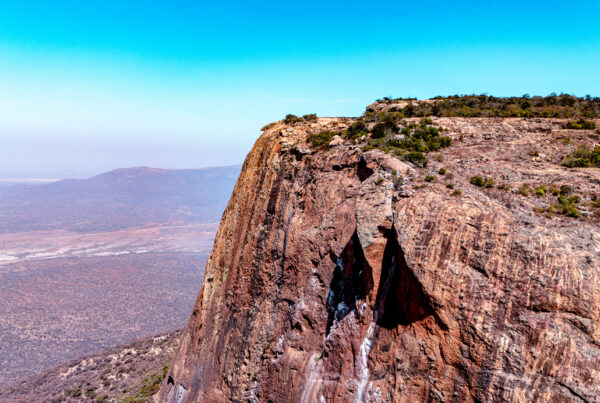
Samburu’s astronomical knowledge extends beyond celestial observations to include the sacred Mount Ololokwe. When loud rumbles emanate from the mountain, they signal approaching rains. In response, the community makes pilgrimage to offer sacrifices on the mountain, maintaining their deep spiritual connection to this sacred peak where special medicinal plants grow.
This integration of celestial and terrestrial signs demonstrates the holistic worldview that has sustained the Samburu people for generations, where earth and sky work in harmony to guide community life.


Special Celestial Events in Kenya
For astronomy enthusiasts seeking extraordinary experiences, Benson recommends timing your visit to coincide with these spectacular celestial events:
The Perseids Meteor Shower
The Perseids Meteor Shower (July 17 – August 24): Active from mid-July through August, this shower peaks around August 12th when you can witness up to 100 meteors per hour streaking across the dark Samburu skies. This is perhaps the most spectacular stargazing period, when hundreds of meteors streak across the sky simultaneously. As the sun shifts to the tropics during this time, you’ll also enjoy optimal viewing conditions for constellations from both northern and southern hemispheres.
Multiple Planet Viewing
Multiple Planet Viewing (September to mid-January): During certain periods, particularly in the months between September and January, you may be able to observe multiple planets – including Mercury, Mars, Venus, Saturn, and Jupiter – visible in the night sky at various times throughout the evening
For those drawn to Kenya’s lush transformation, the green seasons (April to May and October to November) bring their own enchantment. As afternoon rains clear away, stars emerge with stunning clarity against skies naturally refreshed by the day’s showers. No matter when you join us, the equatorial magic of Kenya’s night sky promises an encounter with the universe that simply cannot be replicated elsewhere on earth.

Your Stargazing Safari Awaits
In our increasingly illuminated world, opportunities to witness the night sky in its full, unmarred glory have become precious and rare. Samburu’s clear skies and minimal light pollution create extraordinary conditions for celestial observation, while our Samburu guides share ancestral astronomical knowledge passed through generations. This isn’t just about offering beautiful night skies—it’s about preserving cultural wisdom while creating new reasons for guests to value and protect these remote landscapes.
Submit your most breathtaking celestial photo to the A Million Stars Over Samburu Astrophotography Competition for a chance to win a safari worth $6,000 at any of our unforgettable camps or lodges.