

I landed at Jomo Kenyatta International Airport on a Tuesday morning, bleary from a red eye out of Mumbai, rolling my single carry-on through the polished arrivals hall. Nairobi greeted me with cool, high-altitude air and the electric hum of a city that never quite sleeps. I had just enough time for a strong Kenyan chai at Java House before it was time for my domestic transfer to witness the great migration.
The short transfer to Wilson Airport felt like stepping through a door in time. Wilson sits 17 kilometres from JKIA and the ride took about 20 minutes, but it belongs to a different era entirely with propeller aircrafts and pilots who know your name. With the help Saruni Basecamp guest relations, I checked in for my flight connection to Ol Kiombo airstrip.
The Cessna climbed out of Wilson and within minutes the city dissolved beneath us. Nairobi’s high-rise centre gave way to red-dust suburbs, then smallholdings, then open acacia savanna rolling south as far as I could see. My eyes were fixed on the scratched oval window the entire way.

Forty-five minutes later the pilot dropped us low over the Mara plains, and I could already see herds of elephants threading across the grassland. The wheels kissed Ol Kiombo airstrip and I stepped out into afternoon heat, the tall grass hissing around the runway edges, and a warm handshake from Basecamp Maasai Mara’s ground team waiting in a dusty Land Cruiser.
Arrival at Camp
Basecamp Maasai Mara sits along the Talek River, in the northern reaches of the Maasai Mara National Reserve’s community conservancy. The camp is intimate with just a handful of tents, elevated on wooden platforms under a canopy of fig trees, with the river sliding unhurried below.
The camp’s manager Tonkei along other staff members met me with a cool wet towel and a glass of hibiscus and lemonade juice, and immediately began telling me about what the morning’s scouts had reported and the anticipation of the long awaited migration episode.
As I sipped my drink, he walked me through the camp’s map, explaining conservancies Saruni Basecamp operates in and how the 1.2 million acres of community land surrounding the reserve offers something the national park cannot.

While I came for the migration, it was reassuring to learn about the space, silence, and access that the conservancies offer alongside the reserve. I was sold, especially on the night drives and walking safaris, but first, the experience already unfolding before me deserved my full attention.
I had been told about an evening game drive but opted for rest after the jetlag. What I expected to be a slow afternoon had other plans. A dazzle of zebras came to the river to quench their thirst, and after a nap that lasted far less time than I’d hoped, I was introduced to Enjoolata Centre where I met tens of Maasai women and even learnt how to bead.
Then came the organic gardens which stopped me in my tracks. There was something quietly astonishing about standing among beds of vegetables, herbs, and fruits coaxed from this soil, destined for my table that evening.
The Migration; Nature, Unfiltered
I won’t pretend I fully understood what I was about to witness when my guide Leki woke me at 5:30 am. The camp was still dark, the air cold enough that I pulled my Maasai Shuka tight as I chugged a cup of hot coffee. The migration, I was beginning to understand, begins long before you reach the river.
We crossed the bridge into the reserve, where our open-sided Land Cruiser waited on the far bank, the bush already pressing in around it. Leki introduced us to one another, handed out personalised water bottles, and we set off into the early morning light. Giraffes moved between the trees, elephants crossed unhurried in the distance, buffaloes grazed in loose herds. Occasionally we’d slow for a leopard slipping through the grass, or a lion at rest, but the Mara River, and what awaited there, kept calling us forward.
We found our position at the crossing point and waited. This is something no one tells you about the migration: it is, in large part, an exercise in patient watching. Other vehicles held their positions nearby. Leki was quietly confident, the signs were right, the herds were close, and none of us dared suggest leaving. To move was to risk missing everything.

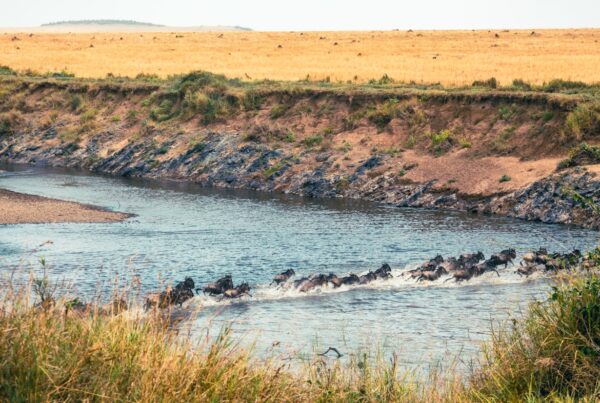
Slowly but surely, wildebeest and zebras began gathering by the thousands on the river’s bank, pacing, testing the water, retreating, and gathering again. Leki explained that they were scenting for crocodiles, reading the currents, waiting for one animal brave or panicked enough to go first.
Then, suddenly, it happened all at once. The sound was not what I expected. It began as a low trembling underfoot before it grew into something that filled my chest entirely.
For over five hours, we watched them pour over the bank in a torrent, tens of thousands of them scrambling, leaping, swimming hard against the khaki current. Crocodiles erupted from the water with a violence that made me flinch. Some wildebeest stumbled. Some did not make it. But the mass moved on, unstoppable, climbing the far bank in a cascade of hooves and dust. I had travelled across Asia and North America to witness wildlife. But this migration was something else entirely. It was a reckoning with nature at its most honest.
I was the first to quietly step back. The ones who crossed safely filled me with something close to joy. But the ones who didn’t began to weigh on me in a way I hadn’t anticipated. I turned my gaze to the other spectators, and when the moment had passed for everyone, we drove back to camp in a silence that felt entirely appropriate.
Beyond the Migration

The crossing was the headline, but the Maasai Mara wrote many smaller stories around it. On my third morning, Leki spotted a pair of cheetah cubs tumbling over each other in the tall grass while their mother watched the horizon with cool amber eyes. We sat with them for over an hour. We were the only vehicle.
That evening he took me on a guided walk along the river, pointing out the tracks and signs of animals that had passed in the night. A leopard had dragged an impala into a fever tree at some point after midnight. Buffalo dung, still warm. The barest suggestion of a lion’s pugmark in the clay at the water’s edge. The bush, Leki explained, is a text and he has been reading it his whole life.
That, I think, is the real luxury here. Not the thread count or the cocktails. It is having someone like Leki beside you, translating a world that would otherwise remain closed. The migration brought me to the Maasai Mara but it was these quieter moments that made me understand why people come back.
The Mara does not let you go easily. I am already thinking about when.
Planning Your Migration Visit: A Few Honest Tips

01. Timing is everything
The river crossings typically peak between July and October, when the herds push northward into the Mara. The migration draws visitors from across the world, and these months fill quickly. Book well ahead.
02. Be patient at the crossing
The wildebeest set their own schedule. You may wait three hours and see nothing. You may wait twenty minutes and witness five thousand animals in the water at once. Bring a flask of coffee and surrender to it entirely.
03. Talk to the staff
Your guide and your camp team carry decades of knowledge about wildlife, land, culture, and community. Ask them questions. Listen carefully to the answers. Some of the most memorable moments of a migration safari happen not at the river, but in the quiet conversations between drives.
The migration waits for no one. If this year feels like the right time, our team is ready to help you plan every detail, from your first flight to your first morning at the river.