

”In the pre-dawn darkness of Samburu, as the last stars fade into morning light, award-winning Bulgarian astrophotographer Rositsa Dimitrova adjusts her camera one final time. Her lens has captured galaxies from 35 countries, but tonight—her fourth night under Samburu's pristine dark skies—something feels different.
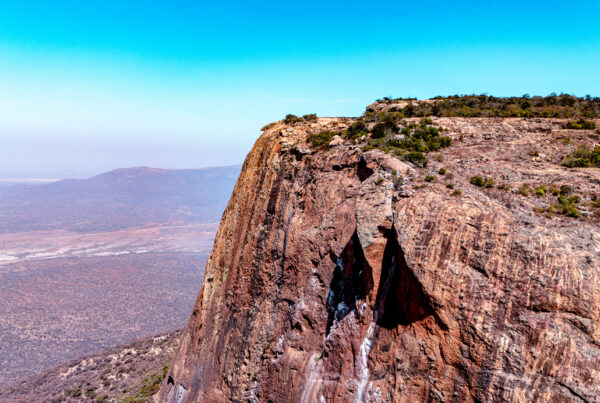
The Milky Way arcs overhead with an intensity that stops conversation mid-sentence. Below, the silhouette of Mount Ololokwe rises against the star-filled canvas, its sacred peak holding stories that stretch back millennia. For Rositsa, this isn’t just another shooting location—it’s where technical mastery meets profound cultural significance, where the cosmos reveals itself with startling clarity.
From Geometry to Galaxy
Rositsa’s path to astrophotography began with a paradox. “I’m a very numbers-oriented person and never considered myself artsy,” she reflects. “But I realized I could turn geometrical compositions—leading lines, circles, light—into art.”
That transformation began during a night sky photography workshop, when she first pointed a professional camera skyward. “It was love at first sight when I saw the photos,” she recalls. What started as technical curiosity evolved into something deeper: a quest to capture not just places, but the emotions they evoke.
Seven months of meticulous planning went into her famous moon phases composite—a project that began with tracking the sun’s journey but became an obsession with lunar movement. “I consulted astronomers to map the moon’s path for an entire month,” she explains. “I had to shoot at specific intervals every day, positioning my camera at exact pixel angles. Weather made it complex—some months were too cloudy to complete the sequence.”
The dedication paid off. That single image, born from hundreds of pre-dawn sessions and an Excel spreadsheet worthy of NASA, established her as one of astrophotography’s most ambitious practitioners.

Beyond Dark Skies: The Samburu Difference
From the cliffs of Madagascar to the salt flats of Chile, Rositsa has chased perfect darkness across four continents. Yet Kenya’s Samburu region—her 35th country—offers something rare even in her extensive catalog.
“Kenya has always been in my plans,” Rositsa explains, “and not just because of the dark skies but the experiences as well.”
“The skies here are darker than Madagascar, and the landscapes are incredibly diverse,” she observes, gesturing toward the acacia trees silhouetted against star trails. “The landscapes range from acacia trees heavy with weaver bird nests to dramatic cliff faces and roaming wildlife. What excites me most is the possibility of capturing an animal in the foreground.”
This fusion of wildlife and cosmic photography represents uncharted territory even for someone of Rositsa’s experience. “There are famous astrophotography spots around the world that unfortunately produce similar-looking shots. Here, you can capture something truly unique.”
Between astrophotography sessions, Rositsa has discovered that Samburu offers something she didn’t expect to find: transformative wildlife encounters that enhance rather than compete with her cosmic work.
“I really enjoy the game drives. Very exciting trying to find the animals and eventually spotting them. My best sighting so far has been that of the lion we found during sunset as he was just waking up. I’ve also enjoyed seeing the giraffes.”
These experiences aren’t separate from her astrophotography—they’re integral to it. “In addition to the amazing night sky, my highlight has been the incredible wildlife. I really enjoyed seeing them in the wild and being close to them. This is truly how I wanted to experience nature.”

The Equatorial Advantage
Kenya’s position near the equator provides astrophotographers with cosmic privileges unavailable elsewhere. “You get to see constellations visible in both northern and southern hemispheres—the best of both worlds,” Rositsa explains with genuine excitement.
“I was stunned to learn that in January, during the dry season, one can see the Magellanic Clouds, which are southern hemisphere nebulae. During this visit, I was privileged to see the Southern Cross, mostly invisible from northern latitudes. It’s also unique to see how the Milky Way arcs here.”
This astronomical positioning, combined with Samburu’s Bortle 1 classification for minimal light pollution, creates conditions that even experienced astrophotographers find extraordinary.
Where Culture Meets Cosmos
While many astrophotographers focus solely on celestial drama, Rositsa seeks to weave local significance into her compositions.
“I focus on locations that hold meaning for local people,” she explains. “I created a star trail timelapse with Mount Ololokwe, sacred to the Samburu community, and I make it a point to include local people in my shots and share their stories.”
This approach transforms her work from technical achievement to cultural documentation. Each image becomes a bridge between cosmic wonder and human meaning.
Under the guidance of her guide Wilson, she’s learning to see the landscape through different eyes. “More than ever, I’m very keen to what Wilson says—about the culture, the wildlife, everything. Understanding context isn’t just respectful; it creates better art.”
Perhaps most surprising for someone whose work requires solitary nights under vast skies is how deeply the human element of Samburu has affected her. “People have been so warm, and I’ve felt very welcome here in Samburu,” she reflects.
This warmth extends from her guide Wilson to the broader community whose astronomical knowledge adds depth to her technical understanding. It’s a reminder that the best travel experiences—even for solo astrophotographers—are ultimately about human connection.
For Rositsa, Samburu represents something rare in her extensive travels: a destination that exceeds expectations not just for its skies, but for its ability to transform how we see our place in both the cosmos and the community of life on Earth.


The Art of Darkness
For aspiring astrophotographers, Rositsa’s advice is refreshingly practical: “Go to a very dark place. Start practicing somewhere not too far from where you live, so you’re ready when bigger adventures call.”
Years of refinement have led to her signature technical approach: shooting with a fast 14mm lens wide open at F1.8 or F2.0. “This setup lets me capture 20-second exposures with incredible sky detail,” she explains. “The 14mm focal length forces you to think about the entire composition—not just the sky, but the whole scene.”
In Samburu, this technical precision serves a deeper purpose. Unlike many astrophotographers who rely heavily on post-processing, Rositsa minimizes editing, preferring to capture authenticity in-camera. “I always want to include landscapes to bring out the essence of these locations.”
The Samburu landscape provides perfect subjects for this approach—from the sacred silhouette of Mount Ololokwe to the distinctive umbrella acacias that punctuate the savanna, each frame tells a story that extends far beyond astronomical beauty.
Living in light-polluted Europe has made Rositsa acutely aware of what’s being lost as cities expand their illuminated footprints. “I hope cities understand the importance of preserving dark skies—not just for people, but for wildlife as well.”
Her images serve as powerful advocacy tools. “I urge people to get out of the city more, see it for themselves, and not think these photos are photoshopped.” In Samburu, this conservation message carries particular weight, where community-based initiatives protect both the dark skies above and the remarkable wildlife below.


The Star Bed Advantage
At Basecamp Samburu, Rositsa discovered an astrophotographer’s dream: the elevated star beds that transform into optimal shooting platforms, providing unobstructed 360-degree views essential for her wide-field compositions.
“The star bed offers something I’ve never experienced—the ability to photograph the night sky from a platform specifically designed for stargazing,” she notes. “The elevation eliminates foreground obstructions while the comfort factor means I can spend entire nights perfecting shots without the usual challenges of field work.”
When asked to describe the emotion of standing beneath a truly dark sky, Rositsa pauses, searching for words to capture the indescribable emotion.
“It’s a weird combination of full relaxation and ecstasy,” she finally says. “Very grounding—you immerse yourself in the moment and forget everyday problems.
This transformation extends beyond photography to life philosophy. “Consistently pushing myself has translated to my general outlook on life—I’m less bothered by everyday problems.”
For those who’ve never seen the Milky Way clearly, her message is simple: “They’re missing the feeling of being part of the cosmos. Seeing the Milky Way core—the center of our galaxy—is just amazing.”
As astrotourism gains momentum globally, Rositsa sees Samburu positioned at the forefront of this evolution. “It’s getting more popular, but I see most astrophotographers traveling to the same places. There’s a lot more to be explored, and Samburu is one of them.”
This pioneering spirit—combining world-class dark skies with authentic cultural immersion and transformative wildlife experiences—positions Samburu as more than just another astrophotography destination. It’s a place where cosmic wonder meets earthbound magic, where technical precision serves cultural understanding, where the ancient art of reading stars finds new expression through modern lenses.
As dawn approaches over Samburu and the last stars fade into morning light, Rositsa packs her equipment with the satisfaction of another successful night. In her camera’s memory card lie images that will inspire others to seek their own encounters with the infinite—to understand that in the most remote places on Earth, under the darkest skies, we find not emptiness but connection.
The cosmos, it seems, has room for us all.
Journey Into Light with Rositsa
Walk alongside this master of celestial artistry on an intimate safari designed for those who seek deeper connection with the cosmos. Under ancient Samburu skies, discover how stars become stories through her lens. Private mentorship. Exclusive experience. Email: marketing@sarunibasecamp.com
Capture the Cosmos. Win The Safari Of A Lifetime.
Following in Rositsa’s footsteps, capture your own cosmic masterpiece. Submit your most breathtaking celestial photo to the A Million Stars Over Samburu Astrophotography Competition for a chance to win a safari worth $6,000 at any of our unforgettable camps or lodges.